

The quantum computing industry has no shortage of ambition, but it may soon have a shortage of people.
The UK Quantum Skills Taskforce cites projections that quantum computing could create 250,000 new roles globally by 2030 and 840,000 by 2035. Yet the pool from which the industry recruits remains narrow. Research shared by the London School of Economics found that just one in 54 applicants for quantum roles was a woman, while 79% of quantum companies had no senior female figure.
Closing that gap is a matter of equity. It is also essential to building the strongest possible quantum sector. Useful quantum computers will depend on quantum error correction (QEC), the technology that finds and fixes the errors that accumulate as quantum computers run. Building it requires mathematicians, physicists, computer scientists and both hardware and software engineers. Quantum cannot afford to lose talented people because they assume the field is not for them.
Riverlane’s Bertha Swirles QEC Workshop is one practical way we are trying to change that. The five-day programme gives women undergraduates, recent graduates and post graduates the chance to learn the fundamentals of QEC, work on a real technical problem and see what a job in quantum can look like from the inside.
For Tamsin Sandhu, it was the beginning of a career. Two years after joining the first workshop cohort, she is an Associate Research Engineer at Riverlane and helps to organise the programme for the next group.
A week inside Riverlane
The workshop is named after Bertha Swirles, the mathematician and physicist who worked on quantum theory when the field itself was new. It is open to women at various stages of university education studying maths, physics, computer science, engineering and other analytical subjects. Previous quantum experience is not required.
Quantum can appear to be a closed world, complete with its own vocabulary and an intimidating amount of theory. The workshop starts from first principles. Over the first three days, participants move from an introduction to quantum computing into repetition codes, circuits, QEC and decoders: the classical algorithms that interpret error data and work out how to correct it.
They also learn how varied a quantum company really is. Previous workshops have included a Q&A with Riverlane Founder and CEO Steve Brierley, as well as sessions led by Olivia Buckingham, IP Counsel, and colleagues working across high-performance computing, quantum hardware, research and engineering. Each participant is paired with a mentor, with time set aside for one-to-one career conversations and practical CV advice.
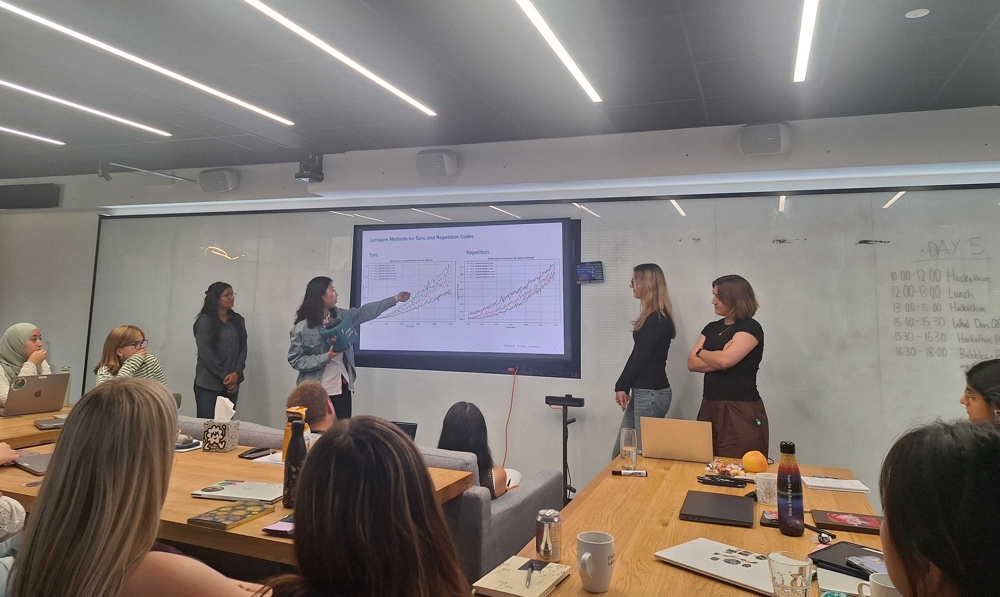
Then the pace changes. The final two days are built around a team hackathon. Participants use code prepared by Riverlane to build and improve a decoder, test ideas and present what they have found. Alongside the talks, they get hands-on experience with a real quantum device. The workshop is demanding by design, but it’s also collaborative. Riverlane scientists and engineers drop in to ask questions, share context and work through problems with the teams.
“The hackathon is probably the thing that stayed with me most,” says Tamsin. “It was the first taste of what you would actually work on. Being able to discuss something related to the company with people at the company felt like quite a big thing at that point.”
When a possibility starts to feel real
Tamsin was completing a Master's in applied maths and quantum physics when she applied. She had already completed an internship in photonics, but QEC was new to her.
What made the possibility feel real was the way Riverlane worked.
“I very quickly felt that this was an environment I’d like to work in,” she says. “The way people worked and talked together really appealed to me.”
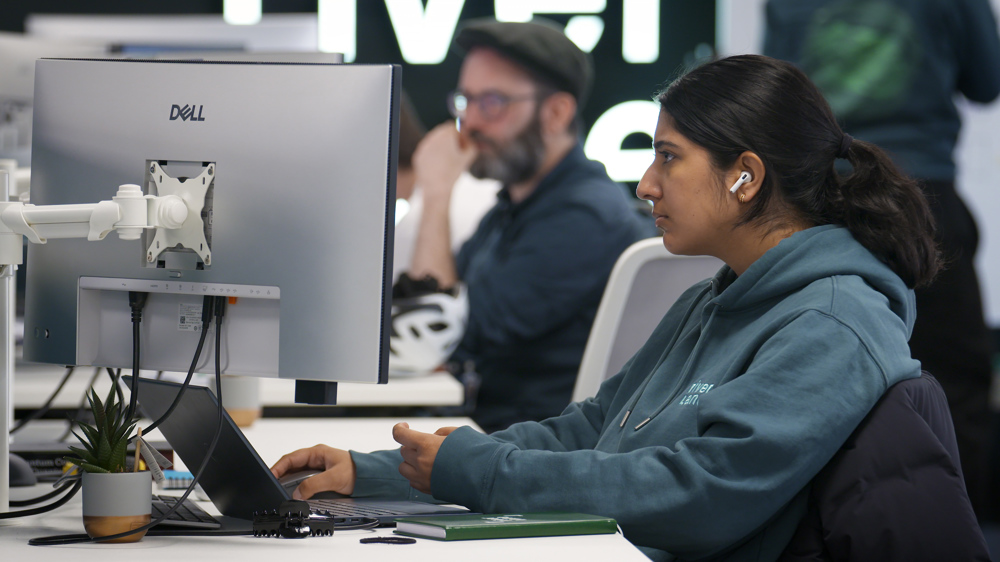
The technical variety helped. Tamsin had expected the maths at a quantum company to be dominated by quantum physics. Instead, she encountered graph theory, group theory and classical algorithms, alongside research and engineering. Around her, the office was covered in whiteboards, with regular technical talks and people solving problems together.
That combination suited what Tamsin wanted from a career. She was looking for somewhere she could use her maths, work closely with other people and contribute to something meaningful. After the workshop, she joined Riverlane. Her role now sits between research and software engineering, allowing her to move between mathematical questions and the code needed to put ideas into practice.
Her return as an organiser completes a useful loop. Tamsin is no longer only imagining a route into quantum or remembering what it felt like to stand at the entrance. She can show participants what came next, answer the questions she once faced and help shape the experience for a new cohort.
Confidence is part of the technical pipeline
The skills shortage in quantum is sometimes described as if it were simply a matter of producing more specialists. In practice, the challenge begins earlier. People need to know that the industry exists, recognise that their existing skills are relevant and feel able to put themselves forward.
One of the most persistent misconceptions is that every role at a quantum company requires a quantum physics degree. It does not. Riverlane needs people from across STEM, including classical hardware and software engineers who may not work directly with quantum mechanics day to day. The problem is broad, even if the label makes it sound niche.
“The aim of the workshop is to say: you are capable, and there are ways you can use the skills you already have,” says Tamsin. “Everyone here has a different degree and a different background, but there’s a way all of you could contribute to a company like Riverlane.”
That confidence needs support after someone enters the industry, too. Tamsin remembers the value of having a female manager who cared about her development and could offer informed advice about working in a male-dominated field. There were still meetings where she was the only woman in a room of 15 or 20 people. Having somebody reinforce that her views mattered made it easier to speak up.
This is why the workshop combines technical teaching with mentoring, career stories and time spent in the ordinary rhythm of the office. Participants do not meet a polished recruitment version of Riverlane. They have lunch with the people who work here, join talks, test ideas on whiteboards and see the many different ways a person can contribute.
A pathway, not a promise
Across the first two cohorts, 23 women have attended the Bertha Swirles QEC Workshop. More than a quarter have since moved into quantum-related industry, academia or postgraduate study. Of the full alumni group, 22% are now software engineers, 35% are continuing their degrees and 17% have moved into other technical or analytical careers.
Those figures do not prove that one week determined what each participant did next, nor is that the claim. They do suggest that early exposure, practical experience and a visible peer network can help create a route into a field that might otherwise feel out of reach.
The scale of the challenge is much larger than one programme. Riverlane's workforce has remained around 30% female in recent years, slightly above the 26% UK technology benchmark but short of Riverlane's 35% ambition. Progress is not linear, and bringing more women through the door is only one part of the work. Companies also need to create the conditions in which people can contribute, develop and stay.
The demand for this year’s workshop makes the appetite clear. Around 120 people applied for 16 places in the programme’s third year. Tamsin would like to see it grow beyond Cambridge, reach more participants and make recorded technical sessions available to people who cannot attend in person.
For anyone wondering whether they have enough quantum experience to apply, her advice is much simpler:
“Don’t be worried that you don’t have the qualifications or the insight yet,” she says. “That is what the workshop is there to give you.”
The point is not only to tell more women that there is room for them in quantum. As Tamsin puts it: “We need you to progress the vision that we have.”
You can watch core sessions from the this year's workshop here