

My journey to Riverlane
Just like quantum computing itself, my background is a blend of several disciplines. I began my bachelor's degree in physics at KU Leuven in 2017, but a growing fascination with quantum and nanoscience drew me towards engineering for my master's degree. The fact that it was a joint-degree Erasmus Mundus programme between KU Leuven and Université Grenoble Alpes, allowing me to live and study abroad for a year right after the COVID-19 pandemic, certainly helped make the decision easier. During that master's programme, I worked on a hole-spin qubit in France at the pheliqs CEA laboratory. Seeing the impact of noise on quantum systems firsthand sparked my interest in quantum error correction (QEC) and ultimately led me back to my hometown to pursue a PhD.
As a PhD student working in QEC, it was impossible not to come across Riverlane, the world leader in the field. Meeting several members of the team at the largest physics conference in the world, APS, in March 2025 only deepened my admiration for the company. From that point on, I knew that if the opportunity ever arose, I would love to join Riverlane. Fortunately, that opportunity came shortly after I completed my PhD, and I was delighted to join Riverlane in October 2026.
What do I like most about working at Riverlane?
Whilst Riverlane offers flexible working options, allowing colleagues to work remotely two days a week, I still choose to come into the office every day. I genuinely enjoy being there. The office provides the ideal work environment, not only for focused time but also for connecting with colleagues. We have a great kitchen area where people regularly gather for informal conversations, and occasionally even to play games, like chess.
What I value most, however, is the people. My team is made up of friendly, curious, and open-minded individuals who I really enjoy collaborating with. It's not uncommon for me to bring up a random question or idea, and I can always count on a thoughtful discussion. I don't think it's a coincidence that the team is so intellectually open. Many of us are generalists by nature, regularly interacting with people across the company and attending a wide range of (internal) seminars to continue expanding our knowledge, and we bring that mindset through to our day-to-day interactions with each other.
What does a QEC Researcher in Applied QEC do?
Riverlane sits at a unique intersection of cutting-edge research and industrial impact. Our teams of researchers develop novel error-correcting codes, algorithms, and decoding techniques, which are then transformed into practical capabilities for Deltaflow, our real-time QEC system. From there, our outstanding Engineering team takes over to integrate these advances into the hardware itself, turning breakthrough ideas into practical technology.
My role sits towards the end of this workflow as part of our Experiments team. I get to play around with the latest versions of Deltaflow which are connected to our partners' quantum processing units (QPUs). The focus is on benchmarking hardware performance and demonstrating novel QEC experiments. In doing so, we help bridge the gap between theoretical and applied QEC, ensuring that our research remains grounded in the realities of partner hardware and operational workflows. The insights we gain are fed back both to our partners and to Riverlane's internal teams, helping to drive improvements across the entire stack.
For me, this role represents the perfect balance between research and industry. I still get the opportunity to investigate and demonstrate novel QEC concepts, but with the added satisfaction of seeing that work directly influence products, our partner’s hardware, and the future direction of the quantum computing ecosystem.
My typical day as a QEC Researcher at Riverlane looks a bit like this…
8:45 — Arrive at the office. I have a small bite at home when I wake up, but I usually finish my breakfast in our office kitchen with a piece of fruit and a granola or protein bar.
9:00 — Focused start. Most of my work contributes to a broader research effort aimed at improving the performance of quantum error-correcting codes on real hardware. I usually start the day by discussing recent results with the team and identifying the next optimisation or hypothesis we want to test. Once we have a plan, I reserve a time-slot on a partner QPU and use simulations to validate the experiment before running it on the real device.
10:30 — First meeting of the day. The two most common meetings in my week are partner catchups and internal team meetings. Our team meetings are a great way to share recent work, showcase new results, and learn from each other. Partner meetings are equally exciting, as they allow us to review progress, coordinate upcoming tasks, and work together towards key project milestones.
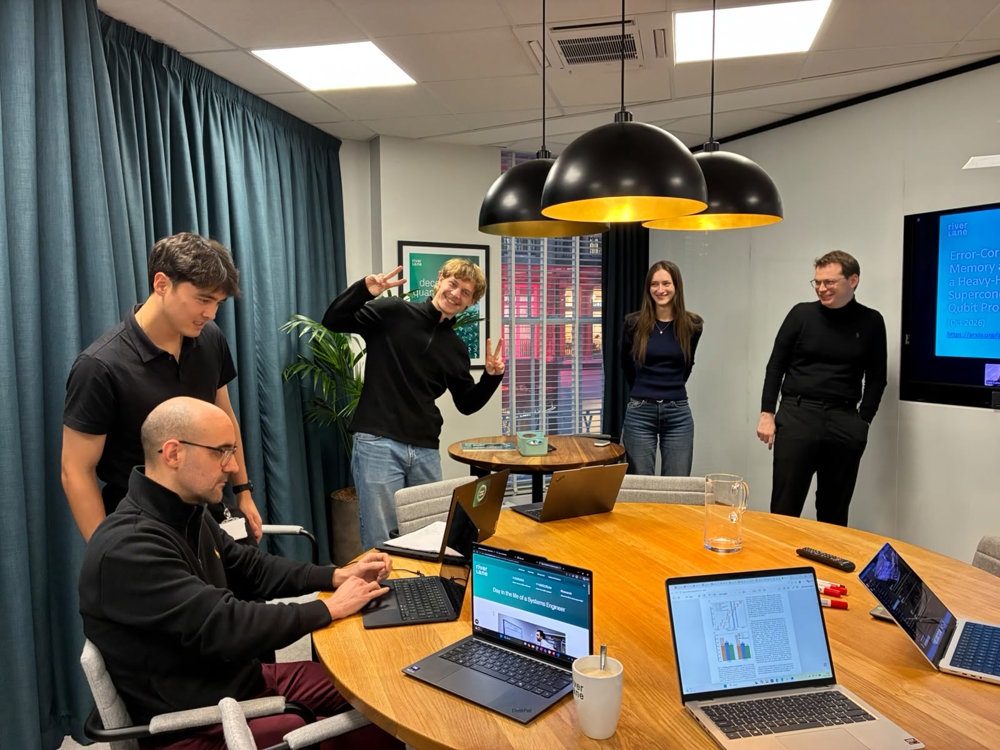
11:30 — A quick code review. Writing code is a big part of what we do. As our experiments evolve, we often develop new tools and features that we contribute to GitHub so they can be reused in future projects. Before merging anything, we ask teammates to review our code, which helps maintain quality and often sparks useful discussions. Some of these contributions even make their way into Deltakit our open source toolkit, where they can benefit a wider community.
12:30 — Lunch. One of the perks of working in central Cambridge is the easy access to the city's fantastic food scene. At lunchtime, we often head to the market or one of the many nearby takeaway spots, then bring our food back to the office to eat together. The well-stocked kitchen is a nice bonus, giving us plenty of options to complement our lunch and enjoy some time together away from our desks.
13:30 — QPU time! Finally, it's time to run the experiment. I connect to the QPU through the cloud and launch the job on real quantum hardware. This is always one of the most exciting parts of the day. After spending some time designing and simulating the experiment, I finally get to see how it performs in reality. Once the measurements have been processed and the results plotted, I can compare them directly against my simulations and start uncovering new insights from the data.
15:00 — Technical seminar. Another regular highlight is our knowledge-sharing series, T and bisqubits. Sometimes a colleague presents their latest work, while other sessions feature the authors of recent papers discussing their research or broader topics in QEC. It's a real privilege to learn directly from the people advancing the field, and it helps us stay up to date with the latest advances in the field whilst uncovering new ideas and experiments to explore on our partner QPUs.
16:00 — Wrapping up. I usually end the day by documenting my findings on an internal web page. As projects mature, these notes evolve into more polished reports that I share with my team and manager. It's always rewarding to publish new results, gather feedback, and spark discussions that often lead to fresh ideas and improvements.
17:00 — End of day. The day always seems to fly by, and before I know it, it's time to head home or join one of the many social activities that Riverlane organises after work. I typically join most sports activities such as bouldering, football, gym and golf.
Looking back, this role offers the perfect mix of research, experimentation, and real-world impact. I get to work on some of the most challenging problems in quantum computing alongside brilliant colleagues, while helping bring fault-tolerant quantum computers closer to reality. If that sounds like the kind of work you'd enjoy, we'd love to hear from you.
Explore our open roles at riverlane.com/jobs.