

In 2025, Quantum Error Correction (QEC) emerged as the universal priority to achieve utility-scale quantum computing, with industry experts recognising QEC as a crucial competitive differentiator to scale and succeed.
In this post, the Riverlane team picked out three key QEC trends from 2025 – as well as three predictions on what 2026 will bring.
For a deeper dive into the QEC landscape and exclusive future predictions from 25 leading quantum experts, you can download The Quantum Error Correction Report 2025 here.
1. Investment, infrastructure, and maturation
Financially, 2025 was characterised by massive investment and industry maturation.
Quantum companies attracted substantial funding, leading to multi-billion-dollar valuations for both public (IonQ, Rigetti, D-Wave) and private firms (Quantinuum at $10bn, PsiQuantum at $7bn, SandboxAQ at $5.75bn, IQM over $1bn).
As the industry matures, early signs of consolidation are becoming evident through acquisitions. These include IonQ's purchase of Oxford Ionics and Google's acquisition of Atlantic Quantum, signalling a move towards a more integrated landscape where smaller but technically strong startups are finding homes with larger players.
This financial dynamism is paralleled by the emergence of a specialised, layered quantum supply chain, mirroring the historical development of the classical semiconductor industry, as Chip War author, Chris Miller, explains in this article.
2. Geopolitical and human challenges
Governments and geopolitical forces actively shaped the quantum landscape in 2025. Initiatives like DARPA’s Quantum Benchmarking Initiative (QBI) led the charge, aiming to procure a $1 billion quantum computer by 2033, and the US Department of Energy's Genesis Mission, launched in December, targeting a "Manhattan Project"-like ambition.
New programs are now anticipated from Canada, Europe, and the UK, reflecting a global race for dominance. And while China continued to produce a high quality and quantity of quantum research, geopolitical tensions, such as Trump's tariffs, posed risks to global supply chains, prompting calls for diversification and increased R&D in quantum.
2025 also highlighted a critical quantum human challenge: a severe and growing skills gap. Specialised skills are in particular demand. For example, for QEC, there are only an estimated 600-700 QEC specialists worldwide. Yet, 5,000-16,000 are needed by 2030. The industry faces a substantial pipeline problem, as QEC training can take up to 10 years.
3. The QEC code explosion
Following Google’s Willow chip announcement in December 2024 (when we saw the theory of QEC clearly bringing errors down in practice), QEC made the leap from a theoretical concept to tangible hardware implementations in 2025.
One area of substantial growth was QEC codes. A QEC code uses multiple noisy physical qubits to create a single, more reliable logical qubit by distributing the quantum information redundantly.
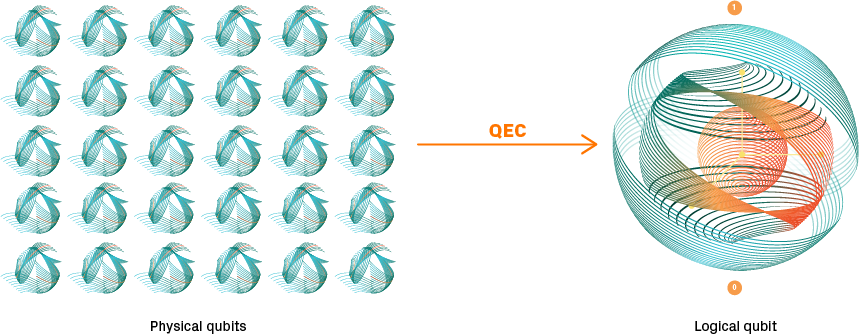
Figure 1: QEC is crucial for turning unreliable physical qubits into useful, logical qubits by encoding information on multiple qubits.
There was a significant increase in published research on QEC codes in 2025 (120 new peer-reviewed papers between January and October 2025, up from 36 in 2024). This shift reflects growing confidence and interest among companies exploring multiple QEC approaches, as evidenced by the diverse range of code types in production.

Figure 2: A comparison of peer-reviewed QEC code papers by code type, 2009 to 2025.
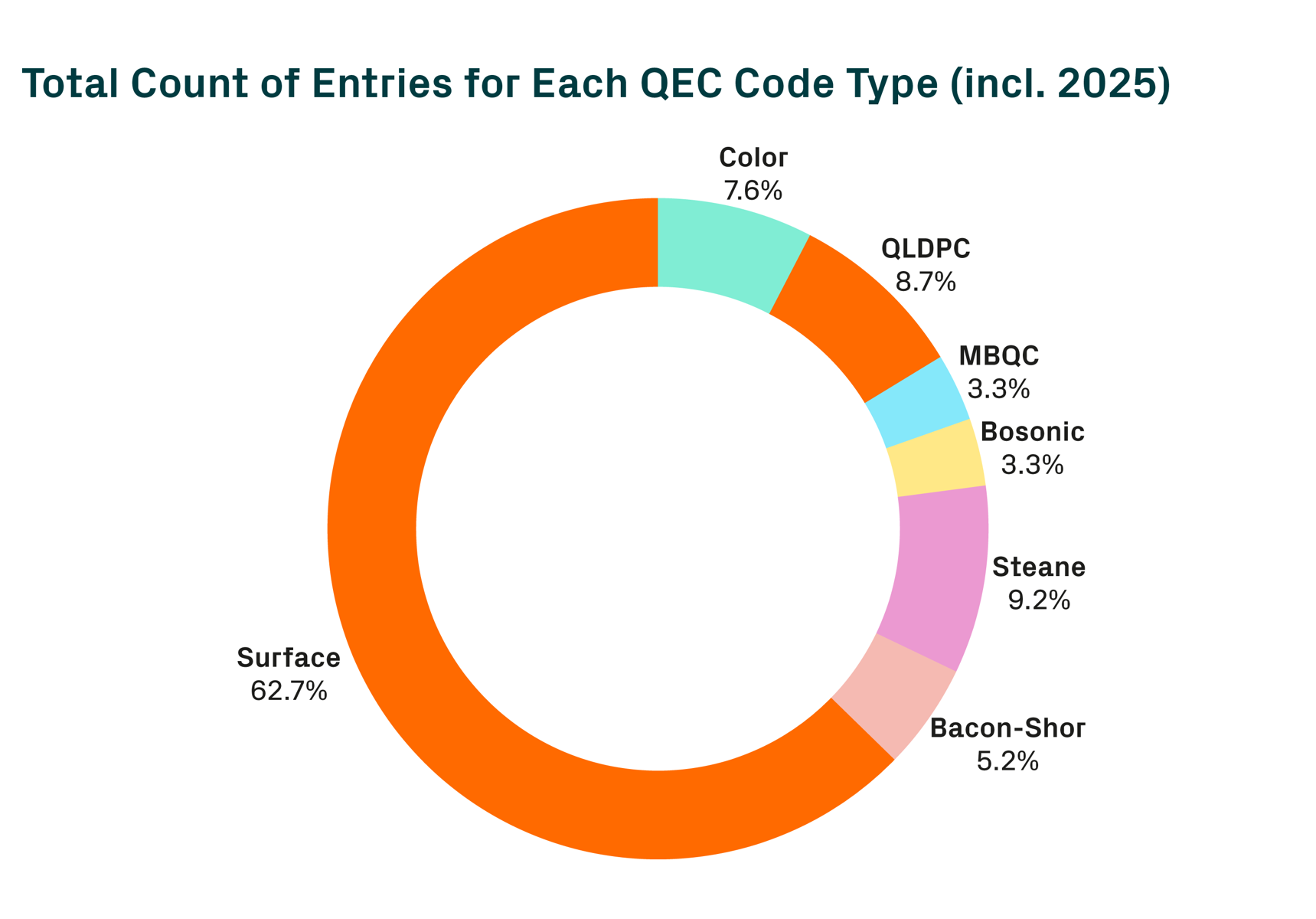
Figure 3: A comparison of peer-reviewed QEC code papers by code type, 2009 to 2025
This ‘QEC code explosion’ demonstrated a clear shift from theoretical ideas to practical implementation, with the seven main QEC codes all implemented on hardware.
The tight alignment between QEC codes and hardware (qubits) also became evident this year. Following IBM's transition to qLDPC codes in 2024, we predict other industry players will follow suit in 2026, yielding diverse fault-tolerant quantum computing architectures tailored to specific hardware platforms.
But it’s when we take a holistic approach that the true power of quantum is unlocked: using a combination of smarter software, increasingly efficient systems (including error correction), and higher-quality qubits, one paper also demonstrated that breaking RSA encryption may require only one million qubits, down from earlier estimates of 20 million.
What else can we expect in 2026?
1. The “first FTQCs” will emerge
Oxford Ionics achieved a 99.99% fidelity for two-qubit gates in 2025 – a significant result that shows the quality of its qubits. We expect a surge of similar logical qubit announcements in the year ahead. However, this metric tells an incomplete story as it doesn’t indicate how many error-free quantum operations (QuOps) those logical qubits can perform.
While achieving impressive individual qubit performance and low error rates remains crucial, the industry will pivot towards a much more ambitious and systemic goal. Instead of simply showcasing isolated 'logical qubits' (which, while impressive, don't yet perform a sufficient number of QuOps), leading companies will focus on building the first Fault-Tolerant Quantum Computers (FTQCs).
These 'first FTQCs' represent a monumental step because they involve integrating multiple imperfect physical qubits into a complete, albeit small, system that can reliably perform computations, even in the presence of noise. This 'systems-level' approach is paramount because it allows developers to understand and master the intricate challenges of building and operating an entire fault-tolerant quantum computer from the ground up. It’s akin to learning how to construct and fly a simple, working airplane – not just perfecting a single wing – thus initiating a vital learning-and-scaling cycle.
This foundational work, driven by a small cohort of leading quantum hardware companies, will be essential for gaining a competitive advantage and accelerating the path toward truly utility-scalable quantum computing as we move beyond 2026.
For those keen to explore the intricacies of building the world’s first FTQCs, our detailed whitepaper offers invaluable guidance, available to download here.
2. QuOps to cut through the noise
At the start of the year, we saw the tech bros disagreeing about when we would achieve ‘useful’ quantum computing. Jensen Huang conservatively estimated 15-30 years for "very useful" applications (and then backpedalled on this forecast in March), while Bill Gates offered a more optimistic 3-5-year forecast for utility, which is more realistic and aligns with industry-wide roadmaps.

Figure 4: A consolidated view of past and present quantum technologies and investments.
This lack of clear, consistent communication about machine capabilities and real progress has hindered understanding. However, a pivotal shift occurred in 2025 with the growing recognition of "QuOps" (error-free Quantum Operations) as the definitive metric for charting progress.
QuOps provide a transparent, measurable standard for understanding what any quantum system can reliably achieve, moving beyond ambiguous terms like "quantum advantage." This clarity also enables a generational roadmap (KiloQuOp, MegaQuOp, GigaQuOp, TeraQuOp), similar to mobile network evolution (2G, 3G, 4G, 5G), giving the industry a common language.
In 2026, this move towards standardisation will intensify. The industry will pivot sharply from vague claims towards demonstrating tangible business value and practical utility.
Success will no longer be measured by simple qubit counts or theoretical "quantum advantage" experiments, but by the concrete progress indicated by QuOps – emphasising long-term investment, engineering realities, and demonstrable real-world applications over mere proofs-of-concept.
In short: QuOps not “quantum advantage” experiments or number of logical qubits are how to measure real success in 2026.
3. The global race for talent is on
The critical shortage of quantum expertise, particularly in specialist areas like QEC, will intensify in 2026, driving further consolidation of talent. Rather than a wave of large-scale mergers and acquisitions, we anticipate a more nuanced form of talent consolidation, with top-tier specialists gravitating toward the most promising and well-resourced environments.
Geopolitical factors will continue to fuel the rise of national and regional champions, with countries and regions increasingly specialising in the technologies needed across the quantum stack.
Simultaneously, geopolitical tensions will increasingly impact global quantum supply chains, prompting a push for diversification and increased domestic R&D investments to mitigate reliance on specific international suppliers.
Despite these challenges, strategic cross-border collaborations will remain crucial for advancing the field, even as political uncertainties persist.
Ultimately, with unprecedented funding and a scarcity of top-tier expertise, the best minds and teams – whether focused on QEC, novel qubit designs, or algorithms – will increasingly gravitate towards the most promising and well-resourced environments, fostering a concentration of the talent essential for quantum computers to reach utility-scale.
And finally…
In 2026, Quantum Error Correction will continue to be the beating heart of the quantum computing industry, marking the true beginning of the sustained engineering and collaborative effort needed to build utility-scale quantum computers.
We look forward to tackling these complex challenges hand-in-hand with our partners and Riverlane’s dedicated team of QEC experts.
Want to be part of the team tackling quantum's most critical challenge? Discover how you can join us in building the future of computing here.
Merry QEChristmas!